 |
| http://www.michaelfrye.com/landscape-photography-blog/wp-content/ uploads//2012/09/0212-10781.jpg courtesy of Michael Fry Photography |
A while ago, we were assigned to read Professor William Cronon's "The Trouble with Wilderness; or Getting Back to the Wrong Nature". The reading was an eye-opener for me. Although I enjoying occasional outdoor activities, I am not a fan of wilderness. The connotation of wilderness was always eerie and uneasy to me.
However, I do admire nature and its majestic scenery.
I felt the beauty and the grand presence of nature when I went to Niagara Falls. The feeling that I got on the boat is certainly not ordinary. You can't help but to be in awe at the glorious scenery.
Even to me, that conflicting feeling sounds very hypocritical, but that is how I feel. Really.
To be honest, I never really thought nature and wilderness to be the same thing. Nature has the connotation of being serene, a haven for reflection and solitude. Wilderness, on the other hand, oozes sense of unknown, darkness, and loneliness. Maybe it's just me, but ever since I was young, the concept of wilderness always seemed to involve a sense of danger. For an example, a renown novel by Gary Paulsen, Hatchet is about a thirteen-year-old boy who is stuck in the wilderness after a plane crash. I read it seven years ago, but this novel engraved the feeling of vulnerability we feel as humans in wilderness. Ever since then, I distanced myself from the opportunities of experiencing wilderness, as I saw myself weak and defenseless against it.
 |
| http://www.bookcounty.com/492-504-large/hatchet-by-gary-paulsen.jpg |
The Sublime was driven by the Romanticism (that originated from Europe and later came over to America) prevalent in the mid 19th century. One of the most influential figure in America was Henry David Thoreau. I actually read Thoreau in high school. I read his perhaps the most famous work, Walden, which is an autobiography of the two years that he spent in a shack that he built near Walden (pond on his friend's property). In his description of wilderness, he personifies wilderness as a companion to his solitude. He is not "alone" as the critters and raindrops comfort and console him. He further emphasizes the perfectness of the wilderness as he tells the story of rules and laws in society that he has to abide by (yet he disagrees with). The minimalism of human contact (social structure or society) is better than living among other people, in Thoreau's opinion. Thoreau depicts the wilderness as the utopia. In addition, other Romantic writers exalted the wilderness to be some type of holy place to feel the magnificence of the nature and God.
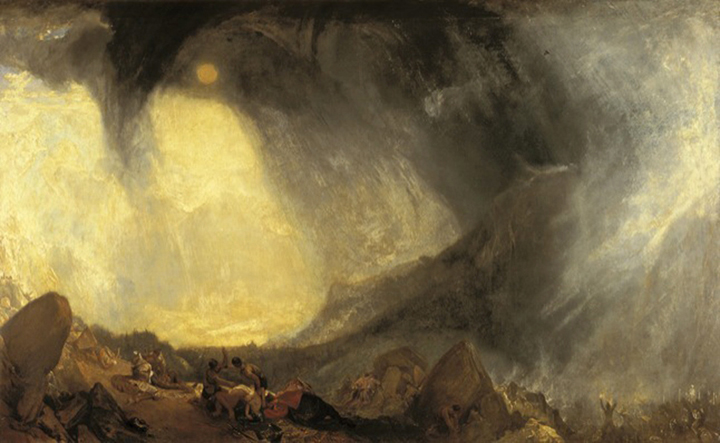 |
| http://we-english.co.uk/blog/wp-content/uploads/2009/01/070924_turner07_p646.jpg Snow Storm: Hannibal and his army crossing the Alps, JMW Turner (1812) |
The idea of "frontier" is very familiar. After all, that was part of the motto of Manifest Destiny, also, an essential part of American Identity. The willingness to protect- a part of what is considered to be a part of American- wilderness was an epochal epiphany that was persuasive enough to initiate a movement. However, this does not resolve the detachment that I feel to "wilderness" but not to "nature".
To look deeply into the difference between the two, I searched for the definitions.
Then, according to the definition, nature can be either...
 |
| New York City at Night, Picture by Paulo Barcellos Jr. http://www.flickr.com/photos/trodel/3599402248/ |
 |
| http://www.zastavki.com/pictures/1280x1024/2009/ Nature_Sundown_Sunflower_fields_at_dusk_015996_.jpg |
I didn't know the exact meaning of nature as stated above. In actuality, nature has a much bigger meaning than I thought. Nature doesn't have to be "natural" in order to be a part of nature. Rather, it can be a skyscraper or a sunflower fields. Any tangible environment is nature. So that means that we are a part of nature, and that the closeness that I feel is only natural. Wilderness, on the other hand, exists when it is untouched by humans. Thus, the visiting wilderness is actually corrupting the definition of wilderness. If that is true, then wouldn't visiting the wilderness, like Thoreau said we should, actually be destroying the essence of "wilderness"?
'Give me the ocean, the desert, or the wilderness!' " (Thoreau, "Walking")
There is a slight difference in the way that Thoreau depicts between wildness and wilderness. It seems as though he is describing wilderness to be a separate category from any other natural environment (probably referring to the grassland/forest) but wildness is the ultimate aggregation of natural environments.
In my opinion, wildness and wilderness is fundamentally same, just the scope of which the word holds is different. However, the word "nature" is beyond those words, as it pertains to every surrounding in society. I can't say that I agree with the Romantic writers, in terms of living in the wilderness. However, I still think that environment has to be protected for the future generations. I am adamant that future generations deserve the same quality of environment that I had the privilege of going to as a child, or as an adult in the future. What do I think about the wilderness? I still just hope that I don't get mauled by a bear. But the appreciation for the "wildness" (now used correctly in Thoreau's sense), is still the same. They should be left alone to thrive on its own, without human contact.
 |
| http://www.travelooce.com/grizzly-bear-attacks-tent.shtml sent by Thomas J. |
What do you think the difference between nature and wilderness is? Is there one?

No comments:
Post a Comment