 |
| http://www.ohio.lib.in.us/central/wp-content/ uploads/2012/03/jungle.jpg |
Nowadays, most of the people agree that America is more than just homogeneous white people and that many ethnicity make up what is America. But we do see the picket signs of protests against illegal aliens. This got me wondering about the perception of being an American.
I may be little offending, however, it seems only natural to me that the people who claim to be against illegal immigrants, aren't they in some sense, also descents of illegal immigrants?
When Europeans first came to America, there weren't any established government that guarded the borderline. Rather, they were free to come and go as they pleased (with that being said, not trespassing any "private property" determined by the settlers). Fast-forward to the Irish Famine. There were hardly any regulations for Europeans to enter the United States through Ellis Island, whereas the other side of the continent, in California, successfully passed the first legislation that banned immigrants from entering the once free-to-roam country. The Chinese Exclusion Act of 1882. Later in the urban areas, the poor immigrants from Eastern Europe were exploited and abandoned by the city officials and politicians.
 |
| http://www.theblaze.com/wp-content/uploads/2011/06/immigration.jpg |
 |
| http://www.stopthenorthamericanunion.com/LULACImages/StopIllegalAlienInvasionBanner.jpg |
I am not promoting that we should allow all illegal immigrants to stay and get paid (on welfare) while doing nothing. I'm also strongly against illegal immigrants giving birth in the United States for their children to acquire an American citizenship (later helping the parents to stay in the United States). That is abusing the rights established for the well-earned citizens who will, in turn, participate in the society and give back while working (taxes). The relationship between the nation and its citizen should be mutually beneficial, never a parasite-host relationship.
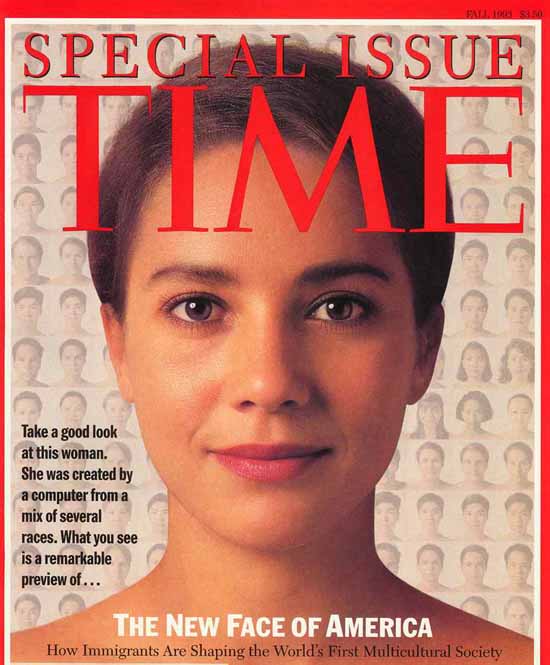
However, the most fundamental principle of being an American cannot persuade me to believe that there is a certain heritage that is "American" and "others" who are not. And also the reason for the barrier is the time in which the families established themselves in America. As America is becoming more diverse in ethnicity, a shocking new revelation hit years ago when the Time Magazine put this on the cover.
 |
| http://www.racialcompact.com/Time_Fall_1993.JPG |
Although this is a cover twenty years ago, it is clear that the European features are slowly disappearing from the "average" face of America. The skin is darker, brown eyes and hair (not to say all Europeans have blue or green eyes and are blonde). Now to 2012. There is an article stated that by 2050, the country will see an exponential growth in minority population and as a result, only half the population will be Caucasian. What do you think of this phenomenon?
The biased views of others are very influential in determining the sense of belonging. It is a natural part of who we are. We predetermine people by their outward appearances. "Don't judge a book by its cover" is well-known, but hardily practiced. But interestingly, we are quite good at determining the social abilities and standings of a person within seconds. This psychological instinct we have living in a society fuels much of the sense of belonging in a particular community.
But fundamentally, the lines we draw mentally exclude some people into our circle of acceptance. In this case, the identity of an American has a definite barriers between the "Americans" and the "others". What makes someone an "American"? (There is a study of average time spent in a typical day of an average American).The culture is definitely part of it. I don't think there is more to it than just lifestyle, but does that mean anyone who shares a different culture from the "classic" American lifestyle is not an American?

I really enjoyed this post. It is interesting how Americans fear other cultures, yet there really is no defined American culture. We are simply a culture made up of a mixture of other cultures. However, there is definitely a problem with illegal immigrants entering our country today. We cannot continue to allow immigrants to enter illegally, have children, and work "under the table". While I think it would be irrational to arrest and deport all illegal immigrants, something must be done. I believe that a solution would have to involve opening up a path for citizenship for those here illegally as well as creating an easier process for people to enter the country legally. We must face the fact that much of America is made up of minority groups, and that there is no standard look or culture for what an "American" is, and we cannot say that one citizen looks more "American" than another.
ReplyDeleteI likewise really enjoyed reading this blog post. I found the attached article on the average American's day particularly interesting--even if I do not think that this is not what it means to be "American." What is an American? is question that is more complex than people originally process it to be and to be honest I never really thought about it before this class. However, I think the answer is a very subjective one. We all have our subjective experiences that make up what we believe what makes someone a true American and what creates the barriers that keeps others from becoming the conception of an American that we have imagined. Personally, I believe that the Time Magazine cover is slightly wrong. The future of America is actually learning to accept others into our boundaries. Yes, there may be more of a "mixing" of cultures than previously experienced, but we are not morphing into one face--we are rather a compilation of a multitude of groups working together (the idea that the US was founded on). Even though I think that the above commenter ignores many of the complications concerning illegal immigration in America today and what prevents them from being “American,” the issue does prevent a problematic aspect of defining the very term “American.” Can we not call these people providing fundamental services pivotal to a functional society, who fervently believe in the freedoms the US stands for, “Americans” because they do not have citizenship yet?
ReplyDeleteHannah, your post inspires me to write several things that have been brewing in my head. First of all, I do agree that America is a melting pot of all different cultures, but I also think that we might not see the growth in the minority population so soon. As it is right now, becoming an American citizen is extremely difficult, and unless one is an illegal alien, the odds of becoming a permanent citizen are not very high, especially considering the cost and knowledge of the country being required. Instead, I think we might actually see a more homogeneous mixture of people where races interbreed until the divisions between races are slim. It sounds a bit foolish and strange, but that's what I've always seen the progression of society to be. As the world gets more accepting of other cultures, people mingle more and more. Those from opposite cultures breed more than ever, and pretty soon, we will have blurry lines about what person is a part of what race. Of course, I have no scientific evidence to back this up, but I always thought of it as the logical progression of society.
ReplyDeleteHannah,
ReplyDeleteInteresting post on a complex topic. What does it mean to be American? This is a confusing question because there is no right answer. There are clearly defined legal guidelines, but even these get muddled at times. So this leaves us in a place where we have a bunch of people living in a space with man-made boundaries all contributing to what it means to be an American while simultaneously maintaining the qualities that make them different from Americans and from each other. Every immigrant group and every individual immigrant came here at different times, from different places, and for different reasons. However, what every person and group shares in common is that, at first, they were oppressed and then they assimilated. The fact that assimilation is possible proves that there is something out there that encapsulates "Americanness." When it comes down to it, though, this definition is flexible and always changing. Maybe being part of a culture that is always in the throws of accepting and opposing outside influences is what being an American is.