Through discussing and reading about philosopher Edmund
Burke, we learn about his endorsement of what we today call Classical Conservatism, in which he emphasized preserving the power of king
and aristocracy, maintaining the influence of landholders against the rising
industrial bourgeoisie, limiting suffrage, and continuing ties between
church and state. When we look at his
views on politics, it is to no one’s astonishment that Burke condemned the
political and social changes that were connected to the French Revolution. While many have criticized Burke’s
“hypocrisy” in supporting the American Revolution yet denouncing the French Revolution, one only has to look at the results of both revolutions to justify
Burke’s views. It is also important to
understand why, if Burke was an intense critic of the French Revolution and its
radical change, why was he a supporter of the American Revolution?
 |
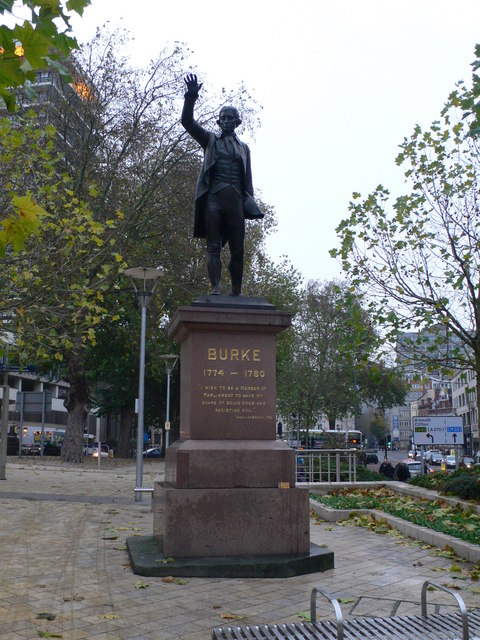
| Edmund Burke, Champion of Classical Conservatism |
Before we can debate on the similarities and the differences
between the two revolutions, it is first critical to understand a bit about the
two. Starting with the earlier American Revolution, the revolution of the colonies was much more than a simple
revolution, more so a war for independence.
After years of “unlawful” taxes, absence of representation in Parliament,
and occupation by British troops, many of the American colonists sought to rid
themselves of the British monarchy through rebellion; and even when
insurrection broke out, many of the American politicians and diplomats thought
of war as a last resort. Once the
Americans had finally gained their independence in 1783, the American people
established a new government to protect the new republic and provide stability.
 |
| Let Freedom Ring! |
Now let’s compare that revolution with the French Revolution. The French Revolution came about
after the French Monarchy, led by King Louis XVI, imposed heavy taxes upon the
masses to pay for the country’s massive debt (which ironically had been
accumulated in large part due to the country’s financial backing of the
colonies in the American Revolution). Influenced
by the teachings of the Enlightenment which called for universal freedom and
equality for everyone, the underprivileged masses held riots, looting and other
forms of social disorder, climaxing on July 14, 1989 when rioters stormed the
Bastille fortress, marking the beginning of the French Revolution and leading
to the drafting of a new Constitution.
Yet with the violent rebellion spreading throughout France and the
execution of King Louis XVI and Marie Antoinette in 1793, the revolution took a
violent turn, resulting in the bloody Reign of Terror, in which suspected
enemies of the revolution were executed by the thousands. It wouldn’t be until 1799, when Napoleon
staged a coup d’état, which the French Revolution officially came to a close.
 |
| The Blade from the Guillotine that Beheaded Marie Antoinette. |
With this information as well as what we know about Burke,
we can now see why Burke supported the American Revolution but not the French Revolution. I believe that Burke
supported the colonists because they in fact were supporting the laws that were
laid down by the British government itself, while the current monarch at that
time was not following them. Even when
war had already broken out (as I had pointed out earlier), the diplomats and
politicians of America continued a futile attempt through the Olive Branch Petition, to remain with the monarchy, as long as the monarchy would also
follow the law (no taxation without representation). It was also a war of independence; not one of
overthrowing a government but one of creating their own government keeping to
the traditions that the British monarchy had failed to live up to. On the other hand, the French objective was
to overthrow the monarchy and set up a democracy through rebellion and
violence, which disgusted Burke.
Pictures found at:
Burke: http://s0.geograph.org.uk/geophotos/02/47/76/2477688_78396c15.jpg
Liberty Bell:
Pictures found at:
Burke: http://s0.geograph.org.uk/geophotos/02/47/76/2477688_78396c15.jpg
Liberty Bell:
Blade from Guillotine:
http://images.cdn.fotopedia.com/flickr-211244502-hd.jpg


No comments:
Post a Comment