Sports have always been an outlet for people to express their innate competitiveness, and ancient cultures even used sport as a means of war.
 |
| Not your typical 'Lax Bros' http://www.personal.psu.edu/mab5448/lacrosse.jpg |
Take the Hillsborough Disaster for example. In the British Premier League, the highest level of English soccer, Liverpool was playing Nottingham Forest in the 1989 FA Cup final. Liverpool is one the most supported teams in all of sports, and thus, the game at Hillsborough Stadium was overcrowded with fans. During the game, the supporters of both teams became rowdy, and even violent with devotion. The influx of more people caused part of the stadium to collapse, leading to 96 deaths, and 766 other injuries. It now remains as the most deadly stadium accident in all of British history. What does this tell us? That sometimes unwavering devotion to a team can lead to tragedies. The same can be said for nations and politics. A leader who becomes obsessed with his country and its sole success will turn into a power hungry monster, only looking to spread his own sphere of influence (does Hitler ring a bell?).
Maybe that's an extreme example, but regardless, certain sporting events over the course of modern history have lead to major political and social changes. Some of the greatest such moments have occurred during a special event every four years that leaves us teeming with pride, and forces us all to come together: the Olympics.
Of course we all know about the "Miracle on Ice" in the 1980 Winter Olympics, and how a bunch of scrappy American college kids beat the superstar Soviets. In the wake of the Cold War, this went far beyond the game of hockey.
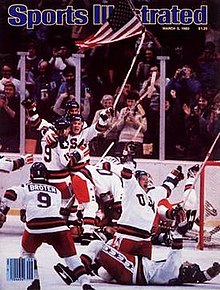 |
| "Do you believe in miracles? YES!" -Al Michaels http://upload.wikimedia.org/wikipedia/en/thumb/b/bd/Sports_Illustrated_Miracle_on_Ice_cover.jpg/220px-Sports_Illustrated_Miracle_on_Ice_cover.jpg |
But still, I'm talking about events that reshaped the way we look at politics and society today.
For instance, take the 1936 Summer Olympics, hosted in Berlin, Germany. During this time, Hitler was mounting his rise to power through the use of propaganda. Such tactics included undermining all races of color, while placing the Aryan race above all others. To Hitler, the Olympics provided an opportunity to profess the "superiority" of the Nazis and his ideal race. Yet, Hitler hit a bit of a speed bump, to say the least. Queue Jesse Owens. The African-American won four gold medals in the 100m, 200m, long jump, and 4x100 relay. By being the most successful athlete at the 1936 Games, Owens not only disproved Hitler (talk about a slap to the face), but he single-handedly brought light to the idea that, "Hey, maybe whites are not superior." Unfortunately, this lead to Hitler increasing his efforts to eradicate all non-Aryans, highlighting the impact sports can have on a nation.
Another example of how political endeavors are started by sport events was the conflict between Israel and Palestine that arose due to the 1972 Munich Olympics. During the Games, Palestinian terrorists, known as Black September, tragically captured and killed 11 Israeli athletes. This lead to an uproar in the national community, especially Israel, who sent special forces to kill Palestinian officials and terrorists. The tragedy not only strained Israel-Palestinian relations even further, but also lead to the creation of a number of European counter-terrorism groups, such as GSG9 and GIGN.
Social reforms are no stranger to the Olympics either. During the 1968 Summer Games, in the midst of the African-American Civil Rights Movement, African-American athletes Tommie Smith and John Carlos won the gold and bronze medals, respectively, in the 200 meter dash. Upon receiving their medals on the podium, the two bowed their heads while raising their fists in the air, as the "Star-Spangled Banner" played in the background. Smith and Carlos were representing the Black Power movement, and this caused a great amount of distress in the US. Today, however this action is remembered as one of the key moments in the Civil Rights Movement, as it politicized the Olympics, and will remain so forever.
 |
| Tommie Smith (center), and John Carlos (right) http://upload.wikimedia.org/wikipedia/en/thumb/c/c8/Carlos-Smith.jpg/220px-Carlos-Smith.jpg |
Just as sports can end conflicts, it can just as easily start them...even wars. La Guerra de Futbol, also known as "The Soccer War," took place in 1969 between El Salvador and Honduras. The two countries were pitted against each other in a qualifying match for the 1970 FIFA World Cup. El Salvador defeated Honduras 3-2, but due to the high tensions between the nations, an all-out war erupted. Why did a soccer match cause this? Well, at the time, Hondurans had an overall resentment towards migrant El Salvadorians who were "stealing" the Hondurans' jobs. The loss was the last straw. After four blood-filled days, 1000 people had been killed, and thousands more injured.
At this point, one can clearly see the overlap between sports and politics. But sports can impact us in religion as well. Even in a seemingly peaceful aspect of life that has nothing to do with athletic competition, there is still no escape. Sports has had a stronghold in representing religion for years, and can be given credit for starting the oldest rivalry in sports: Celtic vs. Rangers. The battle between the two Scottish teams, a battle between Protestants and Catholics, still rages on today, and has a significant impact on Scottish governmental policy in regards to the two factions.
So why do we not recognize sports as a valid political medium? Time and time again, we see examples of how sports can represent nations as a whole, and that they severely impact sociopolitical factors as well. Sports are more than just "games," and teams are more than just "athletes." Those teams represent something more than words can describe. Next time you watch your favorite NFL team play, ask yourself why you care so much. Next time you watch the Olympics or the World Cup, ask yourself why it really matters. You may very well be watching an event that rewrites the course of history.
In closing, watch this video....
...and ask yourself what those people are actually cheering for, and why it feels so damn good to be an American.
At this point, one can clearly see the overlap between sports and politics. But sports can impact us in religion as well. Even in a seemingly peaceful aspect of life that has nothing to do with athletic competition, there is still no escape. Sports has had a stronghold in representing religion for years, and can be given credit for starting the oldest rivalry in sports: Celtic vs. Rangers. The battle between the two Scottish teams, a battle between Protestants and Catholics, still rages on today, and has a significant impact on Scottish governmental policy in regards to the two factions.
So why do we not recognize sports as a valid political medium? Time and time again, we see examples of how sports can represent nations as a whole, and that they severely impact sociopolitical factors as well. Sports are more than just "games," and teams are more than just "athletes." Those teams represent something more than words can describe. Next time you watch your favorite NFL team play, ask yourself why you care so much. Next time you watch the Olympics or the World Cup, ask yourself why it really matters. You may very well be watching an event that rewrites the course of history.
In closing, watch this video....
