While reading Michael Walzer's Just and Unjust Wars, one sentence in particular seemed to present itself to me. "They are most likely to believe that their wars are just, and while the basis of that belief is not necessarily rational inquiry but, more often, a kind of unquestioning acceptance of official propaganda..." Like all wars, religious wars are violent. However, they justified these wars by simply calling it "God's will". Somehow, God wants what is good only for the select few and disregard others for the sake of the few. That God is not the God I was taught to believe in. Rather, it is the exact opposite!
 |
| http://souldiving.com/wp-content/uploads/2011/04/War-Good-For-Few-Bad-For-Most1-e1303497488766.jpeg |
Walzer continues by saying, "...nevertheless, they are not criminals, they face one another as moral equals". The religious soldiers are "not criminals" because they are acting upon what they truly believe is the right thing to do. The soldiers are not intending to hurt anyone out of Moral Equals? I found myself repeating the word again and again. This reassured my hypothesis of Walzer's interpretation of religion not having much influence on the morality of a war.
This clip is from a movie, "Hotel Rwanda", based on a true story. This scene portrays a fraction of the aftermath of the massacre.
 |
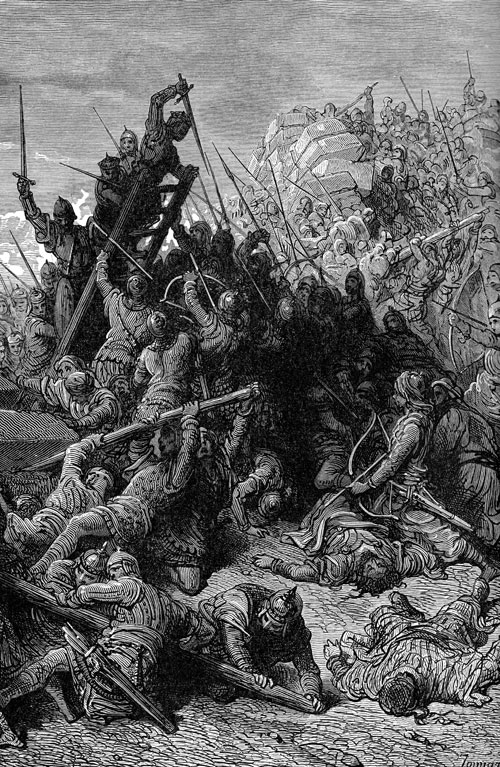
| A painting of the crusade http://www.kidspast.com/images/crusades.jpg |
As society is leaning more and more towards scientific evidence, literature criticizing the irony of the promotion of benevolence and violence has gained popularity exponentially. They claim that religious institutions are hypocrites and that they manipulate to fulfill their desires for more power and money. In addition, the adamant intolerance of religious institutions are regarded as archaic and rather ludicrous.
According to Walzer's writing, Walzer would agree with this critique that religious wars are created based on a propaganda, and that they face each other as "moral equals". Walzer states that when in war, soldiers are equal in terms of morality, thus, the religious identity of a soldier does not matter. Despite how much religious institutions believe and claim themselves to be moral, in the end, they are the same.
In my opinion, Walzer's statement is valid. Although I consider myself to be a devout Christian, based on the evidences, I can say that the religious wars were not any better in terms of morality. I don't believe that just because Christianity promotes peace, religious wars are hypocritical. Rather, I think that the most religious wars had Jus ad bellum, a plausible reason to engage in a war. However, their actions say otherwise.
The despicable, horrendous acts in the war violated the Walzer's stance. Walzer believed that not all acts in war are justified for the purpose of securing a victory, consequently war crimes contradicted the entire Jus ad bellum in Walzer's perspective. I, too, believe that war is not an excuse for any army to cause unnecessary, brutal deaths of the innocent, regardless of the religious identity of the soldier. In the end, religious wars are just as cruel as violent as secular wars as they have not proven themselves to uphold a higher moral standards.
Lastly, when I was listening to the lecture, I thought about this segment of The Daily Show, which surprisingly shares my opinion on the topic of religious war.
http://www.thedailyshow.com/watch/mon-september-17-2012/actual-democalypse-2012---islam-s-growing-pains

First off, I thought you offered a very interesting perspective to a potentially controversial issue. Personally, I agreed and disagreed with various parts of Walzer's piece. I think the quote you cite Walzer that, "...they are not criminals, they face one another as moral equals" holds some bearing; I believe that soldiers are equals on the battleground, but, in my opinion, because the act of war falls within an area of moral void. So, I would agree with your comment that religious wars are just as violent as secular wars, but because war itself is paradoxical in that it must always be judged from a perspective and thus is necessarily susceptible to human bias - whether it be individualistic, national, or religious interest. I therefore disagree with Walzer because I do not believe any justification for war exists which is a truly unbiased one. On a more personal note, I would acknowledge that religion has contributed much violence to human history, however, in contrast to some of the more outspoken atheists on the subject such as Bill Maher, I would not be so quick to pin the blame on religion exclusively. All wars require propaganda, and religion has undeniably proven to be one of the strongest and most unique - in that it supersedes even geo-political/national borders. Who's to say whether our history would evolve any differently without religion; we certainly have proven that there many other things worth killing for.
ReplyDeleteI agree in that the church is not always a morally ideal figurehead. In its vast history, the Catholic church has done a multitude of questionable things that has caused me to wonder. One incident in particular that I learned was in the 1600s, in which Galileo proposed (against Catholic beliefs) that the Earth revolved around the stationary sun. After which the pope imprisoned Galileo and threatened torture unless he recanted his statements, in which Galileo was forced to publicly humiliate himself. The occurrence, like the statements proposed above, has also caused me to question the church's moral ideals.
ReplyDeleteThe ironic thing about Galileo's situation was the Church did no officially pardon him until after we had put a man on the moon in the 1960s, when obviously the truth of his proposition couldn't be argued.
Delete"I think that the most religious wars had Jus ad bellum, a plausible reason to engage in a war." How so? Isn't the reason for starting a religious war basically I don't like you, so I'm going to kill you? Religious wars seem like the epitome of senseless and illogical violence to me. It's the same as ethnic conflicts, just misguided hatred, bigotry, nationalism etc etc. In the protestant/catholic and sunni/shia conflicts, both sides are even of the same religion, further proving the ludicrousness of religious wars. I'm not saying that other forms of war are superior ethically or otherwise, but I would challenge the idea that both sides have a "good reason" to kill each other in religious conflicts.
ReplyDeleteI think that I didn't state this clearly enough. The reason that I believed that they had a plausible reason is that they had their own set of beliefs and justifications for going into the war (not just for the selfish reasons) but for a reason that they actually firmly believed that this war is for the benefit of the society. I, myself, am not advocating any war. I just think that they had a reasoning equivalent of any other wars. (So I'm saying that religious wars are just like secular wars in terms of their justification into the war) I hope this makes it little bit clearer for your understanding. Essentially, they have equal justification of engaging in a war as any secular group. That is the reason I chose the wrods, "plausible reason".
DeleteThis comment has been removed by the author.
DeleteIsn't "I don't like you, so I'm going to kill you" the big reason for a lot of wars? Obviously, in some cases it is as simple as not liking one specific group of people for no other reason than they exist as they do, such as wars based on race, like the Rwandan Genocide, but more often than not, war is not because the attacking army doesn't "like" the people themselves, but what they believe in. This can be seen in religious wars, as mentioned by Hannah, but also in any revolution or civil war. Think back to the American Revolution. The colonists believed they should be represented in Parliament, the British did not. As an over simplified version, that all any war is, a disagreement on beliefs. So, John, under this logic, is any war sensible or logical?
DeleteHannah,
ReplyDeleteI thought you wrote a very interesting article on how religious war is just as immoral as a secular war. In European history we look at the 30 years' war, the last of the "Religious Wars". While they were Charles V was fighting to have Catholic control over the Hapsburg empire, his princes were fighting back for control over their provinces through Protestant religions. These wars went on for thirty years with countries such as Sweden joining in to fight for the cause. I think both secular and religious wars deal with a lot of propaganda that people choose to follow. I think the main difference between a religious war and a secular war is that religious wars come from a pure spiritual belief that you personally believe and will do anything for its success. In a secular war, you may not particularly believe in a cause or support what your ruler wants, so you can always choose not to participate. Everyone knows it is based on politics and the people do not have absolute hate for each other since they know they can be spared if they just surrender. I think religious believers are more prone to fighting until the death and do not know when enough is enough because they believe they are fighting for a religious cause that cannot be solved until conversion or their total victory. Religious wars are more prone to massacres in my opinion because they know that their opponent might not ever surrender and will fight till the death so everyone is the enemy including women and children. A secular war will have much to do with conquering and is prone to massacre, but people are more rational when it comes to fighting because it isn't something they may hold as dear as their religion. While the church may have morals such as though shall not kill, when people believe they are fighting for a cause for their religion, they will justify everything that happens in the war for a good cause and that the enemy would commit the same crime because they are irrational. Political wars also have morals but they also have to follow international code of conduct when it comes to war and cannot do immoral things when they know it was ruin them in the end. Since most of our countries now are based on politics and we don't see as many truly theocratic societies, the main religious wars are within countries and do not necessarily follow international rules.
I think that any ideology or beliefs that has been cultivated in a group for a long time has much more influence, like you said. However, if you look at Rwanda Genocide, religion is not the main reason of the massacre. Rather, it is the cultural difference in an arbitrary line drawn by the Europeans (who did not understand the difference in the two groups)that led to the atrocity. You have a great point that religion motivates people much more than secular wars. However, there are some exceptions, in my opinion. Propaganda is very strong and yes, people may have not fully engaged themselves for the cause. But I believe that secular wars, such as Rwanda Genocide or the Holocaust prove that not only religious motives can murder in masses. Therefore, I think that religious wars are just as, not more "prone" to, inclined to mass murder. Unless you believe Holocaust to be a religious war, (which I disagree).
DeleteWhat we’ve read of Walzer deals mostly with Jus in bello, but I personally am more concerned about Jus ad bellum. If a war isn’t justified then all the people who’ve died as a result of it died for no good reason, regardless of whether the way they died was “moral” according to Walzer. You say that religious wars are not any better in terms of morality. I would say that they are almost always going to be worse. Maybe it’s the atheist in me talking, but I don’t think that religion provides a just reason to go to war. Given that, I would say that any war with religion among its primary causes is going to be morally unjust, so I would argue that however brutal a religious war is, it will necessarily be unjust. For a secular war to be morally worse than some religious one, the secular one would have to have a high quantity and high intensity of atrocities, while the religious one would have to be relatively tame. Either way, however, the religious war is necessarily unjust.
ReplyDeleteHannah, reading the beginning of your post as well as when we learned about Walzer made me think of this exercise we did in class back in high school. Since most laws today come from a religion saying whether or not something is moral, if religion didn't exist, would there be laws, or would it just be like the animal kingdom with people doing whatever they need to survive? What I said was that no, things wouldn't be different than they are now. Anyway, that's not really what your post is about because you talk about war, but it was just something interesting I remembered. What intrigued me about your post the most was the claim religious institutions manipulate their followers to get money. It's something to think about, and I think that some churches do that, but not all. A lot of the time, the money that they raise through collection goes to taxes, bills, etc. but they do manipulate their followers. Not necessarily for profit, but to get by. About Walzer saying that religious warriors not being criminals, I have to disagree. Even if they believe something is right doesn't mean that it actually is. I mean, just look at the Crusades! I don't know, that's just what I think, but I guess it all depends on perspective. Even if they are on morally equal ground, they're still killing one another.
ReplyDeleteI think you bring about great points in your blog. There is no doubt that religions wars have been just as cruel as secular wars. I believe that religion actually increases the brutality of wars and in some cases decreases the moral standars fallowed in war.
ReplyDeleteIn war, every man is fighting for a cause and in this case, in accordance with a set of religious beliefs. In such religious wars, people do no fallow their own moral beliefs, but rather those of their religion. Thus, soliders may do things under religious belief that they may not of otherwise done. Perhaps soliders during the Crusades would not have raped and tortured civilians as they did if they were fallowing their own moral beliefs, instead of those of their religion.