Showing posts with label Jean-Jacques Rousseau. Show all posts

Friday, November 30, 2012

Colonialism, Tibet, and Political Theories

Last week, similar to every year, my nationalist friends posted cliche (celebrating killing native americans) against celebrating Thanksgiving. I know that Thanksgiving is not about celebrating any colonialist tradition, but what my irrational friends were criticizing is really something related to Rousseau's state of nature. 


Using Rousseau's terminologies, Thanksgiving is celebrated because of native american's compassion towards Pilgrims, and native american was killed because of Pilgrims' concept of private property: give me your land or I will kill you. Tragedy happens because Pilgrims are in a state of civilization, while native americans are more closely related to the state of nature. So according to Rousseau, Thanksgiving is really correspondent to killing, it is about civilization's inevitable killing of the nature. 


I am not trying to argue here whether we should celebrate Thanksgiving. What is necessary to discuss is the fact that the same kinds of colonialist tragedy still happens nowadays in the place I care most--Tibet.

In Marxism, we read about an extended version of the invasion of civilization. 

        "The bourgeoisie, by the rapid improvement of all instruments of production, by the immensely facilitated means of communication, draws all, even the most barbarian, nations into civilisation. The cheap prices of commodities are the heavy artillery with which it batters down all Chinese walls, with which it forces the barbarians’ intensely obstinate hatred of foreigners to capitulate. It compels all nations, on pain of extinction, to adopt the bourgeois mode of production; it compels them to introduce what it calls civilisation into their midst, i.e., to become bourgeois themselves. In one word, it creates a world after its own image."
--Manifesto of Communist Party Chapter 1, Marx/Engels

The Potala Palace
That's approximately what is happening in Tibet. When I was in Lhasa (capital of Tibet), I see monks doing business all over the day, monasteries surrounded by business area; from the natives I learnt that some tibetan girls becomes prostitutes for money, and because of the free market, some of them ask for 30 yuan a night-that's less than 5 dollars, a lunch in an ordinary restaurant costs even more. These activities are driven by desires, the arch enemy for every Buddhist, and economics itself is advocating this idea of desires. So maybe internally there is nothing "wrong" with doing business, or with prostitution, but they are not only so wrong but the worst of all the wrongnesses to a Buddhist, which also means, they will end up in hell, they will end up being tortured in afterlife--if they still keep their faith. Of course they can abandon their faith: a tibetan drawer told me that in order for them to "construct" their hometown (which is done by the government), they should firstly be a member in CCP; and every CCP is required to be an atheist and non-religious.

There is also a thing I hated most: tourism. I could remember in front of Jokhang Monastery (one of the most sacred temples in Lhasa), some guy with a Canon tried to take photo of the praying people. He looked through the camera, deliberately compositing his picture, meanwhile pacing forward slowly, finally he stepped on a praying lady (because one step in a Tibetan pray requires people laying down on the ground). Who are the most offensive? Tourist. They know nothing about the culture, and they are in Tibet because 1. "everybody is doing so"-Hobbesian contract; 2. "an unpossessed scenario--praying people, plus my labor-pressing down the shutter, and I create my property-Lockean contract. Why are they touring? Because they are citizen of communist-colonialist China.

Tourist colonialism also brought up environmental problem. Tourists are the free-riders, because they only stay for a short time, so there is no contractarianistic obligation for them to cooperate in the game. Environment protection is a classical example of game theory, yet these things are one-time event for tourists. And a big-brother of free-riders, CCP, says to those Tibetan who are in the state of nature, "see how rich those westerners are, toursim contributed a lot. Tibet has great scenario, let's do some toursim." "What about the environment?" asked a Tibetan. "Forget it, money is everything. Marx said 'infrastructures are determined by economic foundations'. With no money Tibet is nothing."Of course, why should the ignorant big brother in Beijing cares about the environment in Tibet.

I'm still wondering why people would like to apply Marxism in every non-economical area such as Soviet Union and China. Soviet Union practically proved failure of "socialism", and so did China in 60's by the Great Leap Forward and the Cultural Revolution, so we all know that China is economically a capitalist country. "But that's not the end", says CCP, "let's do the same thing colonialists did in the Age of Discovery, let's secretly do some exploit to those who look different to our Han people". Let's turn to the quotation from the Manifesto I brought up in the post, obviously it is the stuff that Marx and Engels are against, but that's also what modern communist party is doing. It seems my previous questions are answered: Marx serves as a guidance showing them how to do ego-benefiting but evil things, and that's why Marxism are widely applied in Third World. Is it an example of dirty hand problem? I am going to say the same thing we said about Hitler: absolutely not. 

There will be two consequence for Tibetan: 1. Some Tibetan Marx arises and write against exploit; 2. We Chinese people celebrate thanksgiving for the extinction of Tibetan.

(Click here and here if you want to know more about Tibet political situation)

Saturday, November 24, 2012

Rousseau's Humanity


Courtesy of michaelrobertmiles.com
We've talked about Hobbes, and we've talked about Locke, but I personally find Rousseau's concept of the state of nature to be the most intriguing. Rather than focusing on the importance of exiting the state of nature like Hobbes and Locke (and their emphasis on the social contract), Rousseau believed that humans were in their purest forms at the state of nature. People worked to satisfy their own needs, and the main reason for inter-sexual relations was to reproduce. There were no emotional attachments or guidelines that decided what a person needed to do. Basically, it would be just like a one-night stand. The only differences between people are physical ones. If you can beat up some guy who's weaker than you, then that's the only way you can be above him (not economically, socially, etc.). 


Equality Among Humans, courtesy of nusu.co.uk
   Now, I can't say whether or not this is true, but it's something to think about. Before society was formed, before there was a language similar to the ones we use now, what was there? We were apes. Do apes travel in packs? No. They work by themselves (not by oneself, but rather extremely small groups of only a few) to survive. I can't say that this sounds unpleasant; the thought of no debts, no social obligations, no responsibilities to anyone other than yourself sounds pretty tempting, but so much would be lost. We wouldn't have fancy (or any, for that matter) clothes, cars, food, etc. We would only have access to what we are able to make for ourselves. But what's crucial is that when we're in the state of nature, we have freedom and equality.

Social Hierarchy, courtesy of us.123rf.com
   Where Rousseau differs from Hobbes and Locke, however, is what he thinks humans should do from the state of nature. According to Rousseau, once people leave the state of nature, inequalities begin to rise. Remember that guy who you were able to beat up two years ago when you were in the state of nature? Now he owns you. He was able to assert control over other people through means other than just physical, and now he owns every corn field in the tri-state area. He's an economic powerhouse, and he has a place in the government because of his property. Just because you're stronger than him doesn't mean you can overpower him anymore. That's right. The guy who is physically weaker than you can control you. Rousseau argued that this was, basically, bad. Humans are no longer equal to one another once they leave the state of nature, and this continues right until the point where there's one person who rules over anyone else. When you think about it, it's basically true. No matter how much you work, there will almost always be someone who is more powerful, richer, and better than you. Sure, there are some exceptions, but even then, those are the people who are at the top of the hierarchy that control everyone else.

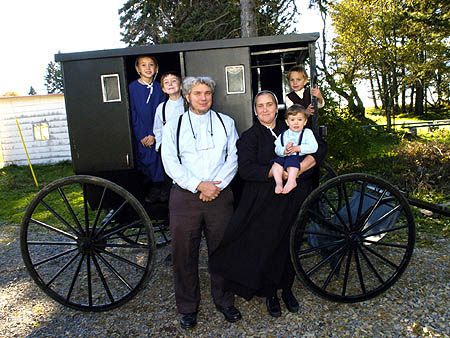
An Amish Family, courtesy of wordpress.com
   It's not all bad, though. Once people leave the state of nature, they begin to work together. Families form, and communities are built. Nobody is alone, and nobody can live by providing everything for themselves. Now, the closest thing I can come up with that resembles this community that isn't quite a civil society would be an Amish town. About thirty people (more or less depending on where it's at) who each specialize in something so that the whole community can live together in harmony. Nobody just works for themselves. There's a farmer, a baker, a cattle rancher, and more, but they work for each other. If a person wants butter, they go to a friend they know who makes the butter rather than buying it from a massive corporation that employs people they don't know. I'm not saying this is a perfect example of a pre-civil societal community, but it's the closest one that I know of that everyone is familiar with.

Captain America, courtesy of Marvel and justjared.com
   Actually, as I'm sitting here watching The Avengers while eating popcorn with my best friend, I realize that The Avengers is also a good example of this sense of community. Captain America is the leader, but he's only the leader from a strategic standpoint. He's not more valuable than Black Widow, the Hulk, Thor, Hawkeye, or Iron Man; he's only the "leader" because he can make the tactical commands, not because he can control everyone else, not because he's richer than anyone else (that feat goes to Tony Stark), or any other reason. He doesn't assert his power over his team; they all work together to accomplish common goals. Outside of the team, each member has his (or her) own advantages, but once the battles start and the team assembles, they work together.

   With all this considered, where would you live: Locke's state of nature, the community stage, or the final stages of civil society? Me, I would probably choose the community stage because there's equality and some aspects of the state of nature while also being able to work together with others. That doesn't mean I'm going to join an Amish community, though (for the record, if I was asked to join the Avengers, though, I'd do it in a heartbeat). What's important to me is my family and friends, which is why I couldn't live in the state of nature, but I am also a fan of being equal to everyone else, and the closest to that would be the community stage.

Below is a clip where Captain America gives orders to the team. He does not assert his power over anyone else; he treats them as equals because they are, yet he also tells them what would be best for the team. They follow his commands because they know that it is best for the city, not because they know he has power over them. He fights with them rather than staying away from the battle and calling orders like most leaders do. This is the ideal sense of community that I described: