 |
| Courtesy of michaelrobertmiles.com |
We've talked
about Hobbes, and we've talked about Locke, but I personally find Rousseau's concept of the state of nature to be the most intriguing. Rather than focusing
on the importance of exiting the state of nature like Hobbes and Locke (and
their emphasis on the social contract), Rousseau believed that humans were in
their purest forms at the state of nature. People worked to satisfy their own
needs, and the main reason for inter-sexual relations was to reproduce. There
were no emotional attachments or guidelines that decided what a person needed
to do. Basically, it would be just like a one-night stand. The only differences
between people are physical ones. If you can beat up some guy who's weaker than
you, then that's the only way you can be above him (not economically, socially,
etc.).
 |
| Equality Among Humans, courtesy of nusu.co.uk |
Now,
I can't say whether or not this is true, but it's something to think about.
Before society was formed, before there was a language similar to the ones we
use now, what was there? We were apes. Do apes travel in packs? No. They work
by themselves (not by oneself, but rather extremely small groups of only a few) to survive. I can't say that this sounds unpleasant; the thought
of no debts, no social obligations, no responsibilities to anyone other than
yourself sounds pretty tempting, but so much would be lost. We wouldn't have
fancy (or any, for that matter) clothes, cars, food, etc. We would only have
access to what we are able to make for ourselves. But what's crucial is that
when we're in the state of nature, we have freedom and equality.
 |
| Social Hierarchy, courtesy of us.123rf.com |
Where
Rousseau differs from Hobbes and Locke, however, is what he thinks humans
should do from the state of nature. According to Rousseau, once people leave
the state of nature, inequalities begin to rise. Remember that guy who you were
able to beat up two years ago when you were in the state of nature? Now he owns
you. He was able to assert control over other people through means other than
just physical, and now he owns every corn field in the tri-state area. He's an
economic powerhouse, and he has a place in the government because of his
property. Just because you're stronger than him doesn't mean you can overpower
him anymore. That's right. The guy who is physically weaker than you can
control you. Rousseau argued that this was, basically, bad. Humans are no
longer equal to one another once they leave the state of nature, and this
continues right until the point where there's one person who rules over anyone
else. When you think about it, it's basically true. No matter how much you
work, there will almost always be someone who is more powerful, richer, and
better than you. Sure, there are some exceptions, but even then, those are the
people who are at the top of the hierarchy that control everyone else.
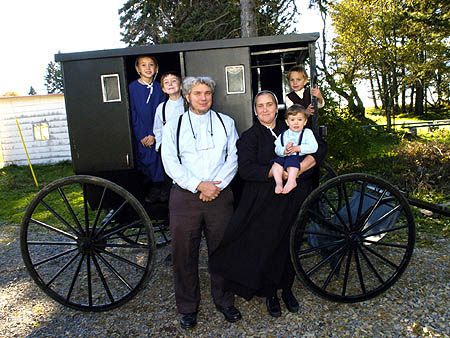 |
| An Amish Family, courtesy of wordpress.com |
It's
not all bad, though. Once people leave the state of nature, they begin to work
together. Families form, and communities are built. Nobody is alone, and nobody
can live by providing everything for themselves. Now, the closest thing I can
come up with that resembles this community that isn't quite a civil society would
be an Amish town. About thirty people (more or less depending on where it's at)
who each specialize in something so that the whole community can live together
in harmony. Nobody just works for themselves. There's a farmer, a baker, a cattle
rancher, and more, but they work for each other. If a person wants butter, they
go to a friend they know who makes the butter rather than buying it from a
massive corporation that employs people they don't know. I'm not saying this is
a perfect example of a pre-civil societal community, but it's the closest one
that I know of that everyone is familiar with.
 |
| Captain America, courtesy of Marvel and justjared.com |
Actually,
as I'm sitting here watching The Avengers while eating popcorn with my best
friend, I realize that The Avengers is also a good example of this sense of community.
Captain America is the leader, but he's only the leader from a strategic
standpoint. He's not more valuable than Black Widow, the Hulk, Thor, Hawkeye,
or Iron Man; he's only the "leader" because he can make the tactical
commands, not because he can control everyone else, not because he's richer
than anyone else (that feat goes to Tony Stark), or any other reason. He
doesn't assert his power over his team; they all work together to accomplish
common goals. Outside of the team, each member has his (or her) own advantages,
but once the battles start and the team assembles, they work together.
With
all this considered, where would you live: Locke's state of nature, the
community stage, or the final stages of civil society? Me, I would probably
choose the community stage because there's equality and some aspects of the
state of nature while also being able to work together with others. That
doesn't mean I'm going to join an Amish community, though (for the record, if I
was asked to join the Avengers, though, I'd do it in a heartbeat). What's
important to me is my family and friends, which is why I couldn't live in the
state of nature, but I am also a fan of being equal to everyone else, and the
closest to that would be the community stage.
Below is a clip where Captain America gives orders to the team. He does not assert his power over anyone else; he treats them as equals because they are, yet he also tells them what would be best for the team. They follow his commands because they know that it is best for the city, not because they know he has power over them. He fights with them rather than staying away from the battle and calling orders like most leaders do. This is the ideal sense of community that I described:


